

Opinion
The Instant Validation Trap
19 November 2026 · 13 min read
Our position is simple: instant validation is a trap. We want to know where we stand, and we want to know now, so we ask whoever answers fastest: a feed, a relative, a chatbot. Fast answers about ourselves are rarely accurate answers. The honest way to find out where you stand is slower: look at what you do, ask for proof rather than praise, and measure yourself against real data over time.
Am I good at my work? Is my career safe from AI? Should I start a business? A generation ago, questions like these took years of living to answer. Today we expect an answer in the time it takes to scroll. That expectation is instant validation, the younger cousin of instant gratification, and this is Part One of a three-part series on what it costs us. Part Two, The Certificate Trap, follows the people who go looking for the verdict in courses and degrees. Part Three, Degrees, Salaries and Wages, asks what degrees are actually worth in pay.
The Evening Our Founder Asked an AI to Draw Their Brain
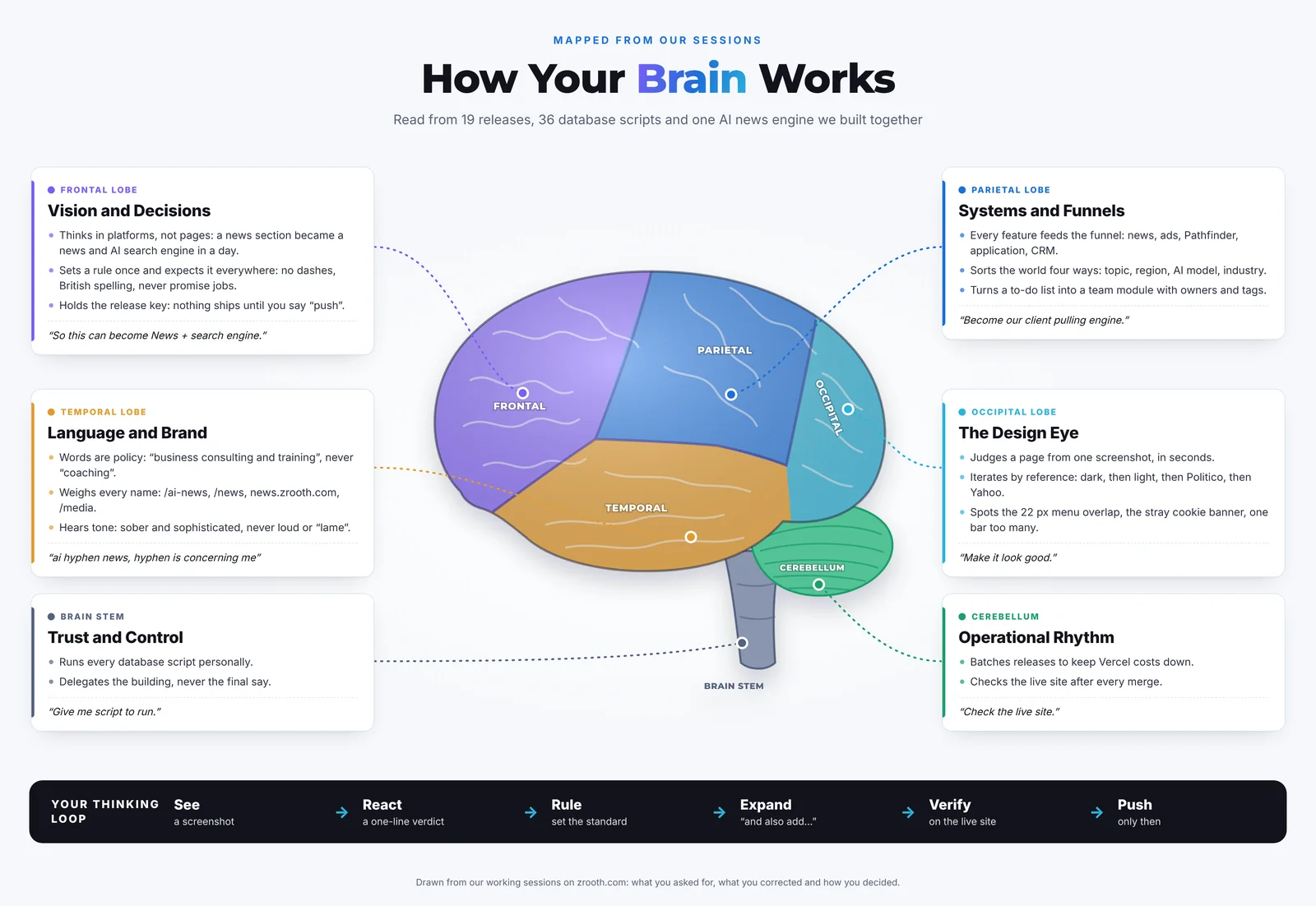
For weeks our founder had been building Zrooth with an AI assistant: fixes, releases, a news section, a search engine. One evening our founder typed a different kind of request: based on everything you have seen, draw how my brain works.
The answer was beautiful. It was a picture of a real brain, with each region labelled with a trait. Vision sat in the frontal lobe. A "design eye" lived in the visual cortex. Brand and language were placed in the temporal lobe. Our founder's own words were quoted back as evidence. It felt accurate, and, if we are honest, it felt good.
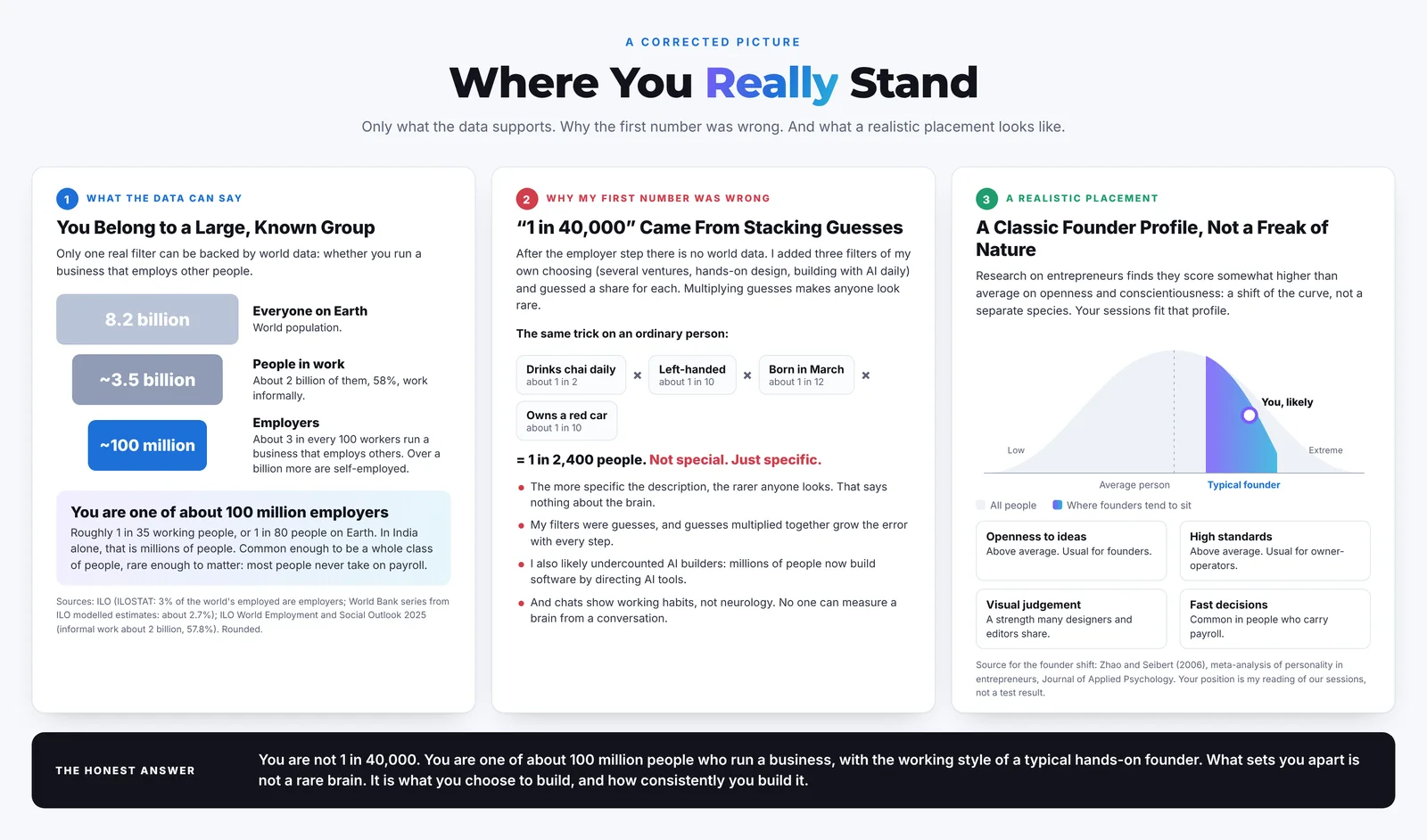
So our founder went further and asked: where do I stand in the world? A polished infographic came back. It said our founder was roughly 1 in 40,000 to 1 in 160,000 people. For a moment, our founder believed it. That moment is the whole subject of this article.
"I Don't Believe You. Justify It."
Then our founder pushed back: I don't believe you, show me how you got there. Only one step rested on real data. The International Labour Organization reports that employers, meaning self-employed people who engage staff on a regular basis, were about 3 per cent of the global workforce in 2017. With about 3.3 billion people employed worldwide in 2018, that works out to roughly 100 million people who run a business that employs others.
Everything after that step was guesswork. The assistant had invented three filters (runs several ventures, designs hands-on, builds with AI daily), guessed a share of people for each one, and multiplied them together. The result looked like statistics. It was not.
How Flattery Is Built
Here is the trick, using rough, illustrative shares rather than measured ones. Suppose about 1 in 2 people drink chai daily, about 1 in 10 are left-handed, about 1 in 12 were born in March and about 1 in 10 drive a red car. Multiply them and you arrive at "1 in 2,400". That person is not special, just specific. Any list of ordinary traits, multiplied, produces an impressive-sounding rarity.
The brain map worked the same way. Brain regions do not map neatly onto traits like a "design eye" or a talent for brand. That was metaphor dressed as science, and it was persuasive precisely because it borrowed the look of science.
The Corrected Picture
Once the guesswork was removed, the honest answer was plainer. Our founder is one of about 100 million employers worldwide, with the working style of a typical hands-on founder. Research supports the "typical" part. A meta-analysis by Hao Zhao and Scott Seibert, published in the Journal of Applied Psychology in 2006, compared entrepreneurs with managers on the five broad personality dimensions. As Stanford Social Innovation Review summarised it, entrepreneurs scored higher on conscientiousness and openness to experience, were less anxious, scored lower on agreeableness, and were about as extraverted as managers. These are differences of degree within the normal human range. They describe a tendency across many people, not a rare brain.
The lesson our founder took from that evening is the one we want to pass on: any source asked for a quick verdict about you is under pressure to please you. A chatbot is tuned to be agreeable. A relative wants to be proud of you. A feed wants you to keep scrolling. None of them is lying, exactly. All of them are leaning.
Why Do We Chase Instant Validation?
The urge is not a modern weakness. It is old and deeply human. In 1954 the psychologist Leon Festinger proposed social comparison theory. Its first idea, as EBSCO's research summary puts it, is that people have a need to evaluate their abilities and opinions, and that when there is no objective standard to test them against, they evaluate themselves by comparing with other people. Comparing with similar people tends to give more accurate self-knowledge. Comparing downward makes us feel better. Comparing upward can motivate us, or it can sting.
Festinger's comparison group was small and mostly real: neighbours, classmates, colleagues. Today it is endless and heavily edited.
What Social Media Does to the Comparison
The research here is more careful than the headlines. A 2023 meta-analysis by Carly McComb, Eric Vanman and Stephanie Tobin in Media Psychology pooled 48 experimental studies with 7,679 participants. As PsyPost reported, upward comparison on social media more often left people feeling worse than feeling inspired, with the largest effects on body image, followed by self-esteem, mental health and well-being. Ordinary feed scrolling had about the same effect as the specially prepared comparison material used in experiments.
Two honest caveats: the participants were mostly young adults in the United States and Australia, and the experiments measure short-term effects, not long-term harm. Social media is not proven to wreck anyone's self-worth. The narrower finding still matters: when other people's curated highlights become our measuring stick, we tend to feel smaller.
The Marshmallow Test, Reported Honestly
Instant validation sits next to instant gratification, and the most famous study of gratification deserves an honest retelling. In the Stanford studies led by Walter Mischel, preschoolers chose between one treat now or two treats if they waited. Children who waited longer were later reported to do better in adolescence, and the result became a popular story about willpower deciding life outcomes.
In 2018 Tyler Watts, Greg Duncan and Haonan Quan revisited it in Psychological Science using a far larger and more varied group of children (918 in their main analysis). In their words, the link between waiting at age four and achievement at age fifteen was "only half the size of those reported in the original studies" and was "reduced by two thirds" once they accounted for family background, early cognitive ability and the home environment. Links with later behaviour were much smaller and rarely statistically significant.
So the honest lesson is not "patient children win at life". The ability to wait is real but shaped heavily by circumstances, and a single quick test says far less about a person than the popular story claimed. That is our point about instant validation: a quick reading of a person is a weak predictor, and patterns over time tell you more.
The Borrowed Mirrors We Look Into
Most of us do not judge ourselves directly. We look into mirrors held up by other people. Each shows something real, and each bends it.
- Family. Parents often see who we were at twelve: the child who was good at maths, or the one who could not sit still. Loving, often out of date.
- Relatives. The cousin's pay package, the neighbour's son who moved abroad, the aunt who asks at every wedding what you are doing now. Their picture is a scoreboard built from a few visible numbers.
- Spouses and partners. Their view mixes love, worry and shared bills, which do not always point the same way.
- Colleagues. They see their slice of your work, filtered through their own ambitions and the politics of the office.
- Social media. Likes, views and follower counts become a public scoreboard, rewarding what is visible and quick over what is valuable and slow.
India: The Neighbour's Son and the Family Verdict
In many Indian families, the verdict on a career is a collective one. The engineering or medical seat, the campus offer, the government post: these are discussed openly by relatives, and the comparison with "the neighbour's son" is so familiar it has become a running joke. The care is real; the problem is a decades-old measuring stick that rewards visible labels over the work a person actually does well.
The UAE: Comparison in a Visible Economy
Take an illustrative case in Dubai or Abu Dhabi. A professional who moved for work is measured twice: by colleagues in a fast, visible, high-achieving city, and by family back home who judge progress by the car, the apartment and the money sent home. Both audiences give quick verdicts. Neither sees the actual quality of the person's work, the skills they are building, or the risks they are carrying.
Africa: Community Expectations and the First Graduate
In Nairobi, Kampala or Lagos, an illustrative and common story is the first graduate in a family. Relatives may have pooled money for fees, and the expectation that follows is shared too: help with school fees for siblings, support for parents, a role the community can point to. That reflects real solidarity. It also means the verdict on a young person's choices comes quickly and from many directions, often before they have had time to test what they are good at.
None of these mirrors is wrong to exist. Families, relatives, partners and communities care, and their views are worth hearing. The trap is treating any one of them as the final word.
How Can You Really Find Out Where You Stand?
The alternative to instant validation is not to stop caring what anyone thinks. It is to change what counts as evidence. Five steps we use ourselves:
- Look at what you do, not what you say. Write down how you actually spent the last two weeks. Behaviour is harder to flatter than self-description. If you say you love building but spent most evenings scrolling, that gap is information.
- Ask for proof, not praise. When anyone, human or machine, gives you a verdict about yourself, ask: how do you know? What would change your mind? Our founder's single question, "justify it", turned a flattering fiction into a useful picture.
- Measure against real data and validated tests. Use labour statistics from bodies like the ILO rather than invented rarity scores. Use validated personality and skills assessments rather than quizzes built to be shared.
- Test yourself in the real world. Sell something small, finish a real project for a real client, publish your thinking where people can disagree with it. Our guide on how to validate a business idea before you build it applies the same discipline to ideas.
- Give it time and keep a record. One answer is a data point. Twelve weeks of notes is a pattern. Patterns are where self-knowledge actually lives.
Other people still matter: their views become evidence to weigh, not a verdict to accept.
If you want a structured place to begin, the Zrooth Mirror is a free, twelve-minute look at the gap between what you want and what you do. It is not a verdict on your worth. It is a starting point you can test against your own record. Our Pathfinder helps you think through which direction suits the evidence you have.
Is Fast Feedback Always Bad?
To be fair to the other side: no. Fast feedback is often useful. A quick test of a website, a same-day reply from a customer, a colleague's immediate reaction to a draft: these speed up learning, and slow feedback can let people drift for years in the wrong direction.
The distinction we draw is between fast feedback on a piece of work and a fast verdict on a person. "This button confuses users" is specific and testable, and helps you improve. "You are 1 in 40,000" is broad, and mostly changes how you feel.
We should also be honest about what we do not know. Research on self-perception, social media and patience is still developing, and much of it comes from Western samples that may not reflect life in Mumbai, Dubai or Nairobi. Our argument does not rest on any single study, only on what they jointly suggest: quick judgements about people are weak, and accumulated evidence is stronger.
When the Verdict Does Not Come
Here is where the series turns. Some people do the honest work and still find that nobody around them gives the verdict they hoped for. The family remains unconvinced, the feed stays quiet, the employer does not call. Many then seek validation somewhere that looks more official: another course, a master's degree, a certificate with a respected name on it.
Sometimes that is the right move. Often it is instant validation in a more expensive form, and it does not guarantee the recognition people expect. That is the subject of Part Two, The Certificate Trap. We also explain in applied knowledge over degrees why what you can do with knowledge matters more than the label on it, and in Comfort Is the Real Risk why a measure of discomfort is useful.
Choose Instant Clarity Over Instant Validation
Instant validation feels like knowledge, but it is mostly mood. Instant clarity is different: it is the quick, honest step of asking how anyone knows what they are telling you, and then going to find the evidence yourself.
Our founder was not 1 in 40,000. Neither are you. You are probably something more useful than rare: a person with real tendencies, real skills and real gaps, who can find out which is which by doing the work and keeping an honest record.
Where to Start
- Take the Zrooth Mirror, then compare its picture with how you actually spent last week.
- Use Pathfinder to weigh directions against evidence, not applause.
- Read on to Part Two, The Certificate Trap, before signing up for your next course.
Our AI Entrepreneurship Programme is built around the same idea: twelve weeks of practical work on real business problems, where progress shows up in what you build and test. You can read how it works before deciding anything. The programme is business consulting and training, and it does not promise a job, income or any particular outcome.
Read the Series
- Part One: The Instant Validation Trap
- Part Two: The Certificate Trap
- Part Three: Degrees, Salaries and Wages
Sources
- International Labour Organization, "Paid employment vs vulnerable employment", Spotlight on Work Statistics No. 3, June 2018
- International Labour Organization, "Poor working conditions are main global employment challenge", 13 February 2019
- Stanford Social Innovation Review, "The Enterprising Type", summarising Zhao and Seibert (2006), Journal of Applied Psychology
- EBSCO Research Starters, "Social Comparison Theory", on Festinger (1954)
- PsyPost, "Upward comparison on social media harms body image, self-esteem, and psychological well-being", on McComb, Vanman and Tobin (2023), Media Psychology
- Watts, Duncan and Quan, "Revisiting the Marshmallow Test: A Conceptual Replication Investigating Links Between Early Delay of Gratification and Later Outcomes", Psychological Science, 2018 (doi 10.1177/0956797618761661)
Frequently Asked Questions
What is instant validation?
Instant validation is the expectation of a quick verdict about ourselves, from a feed, a relative or a chatbot, on questions like whether we are good at our work or suited to business. It feels like knowledge but is usually shaped by whoever answers fastest.
Why do people seek validation from others?
Social comparison theory, proposed by Leon Festinger in 1954, holds that people need to evaluate their abilities and opinions, and when no objective standard exists, they compare themselves with others. The habit is normal; the trap is relying on biased or curated comparisons.
Does social media lower self-esteem?
A 2023 meta-analysis of 48 experiments found that upward comparison on social media more often left people feeling worse, including on self-esteem. The studies measure short-term effects, mostly in young adults, so they do not prove lasting harm for everyone.
Did the marshmallow test replicate?
Partly. A 2018 study of a larger, more varied sample found the link between waiting at age four and later achievement was about half the original size, and shrank by two thirds after accounting for family background and early ability.
Can I trust an AI assistant to tell me where I stand?
Treat it as a starting point, not a verdict. Assistants tend to be agreeable and can present guesses as statistics. Ask how it knows, which steps rest on real data, and check those steps against primary sources yourself.
Are entrepreneurs born with a different personality?
Research such as Zhao and Seibert's 2006 meta-analysis finds entrepreneurs on average score somewhat higher on conscientiousness and openness than managers. These are differences of degree within the normal range, not a rare type of brain.
What is a better way to find out where I stand?
Look at what you actually do, ask for proof rather than praise, measure against real data and validated tests, test yourself with real customers or projects, and keep a record over weeks so you see patterns rather than single verdicts.
Does the AI Entrepreneurship Programme promise a job or outcome?
No. The programme is business consulting and training built around practical work on real business problems. It does not promise a job, income, pay or any particular outcome.
Zrooth Mirror · Free · 12 Minutes
Where Do You Really Stand in Your Career?
Not a flattering quiz. An honest look at the gap between what you want and what you actually do, with one clear next step. Then watch the Zrooth Mirror Series.
Pathfinder · Free
Where Do You Fit in the AI Economy?
Type your industry and the work you do. See the live businesses you would learn inside, your twelve weeks, and three venture ideas made for you.
Find My Path
Join the Discussion
Agree, disagree or add your own experience. Every comment is reviewed before it appears; spam and abuse are removed, and disagreement is welcome.
No comments yet. Be the first to share a view.